
Introduction
In Union of India v. Maytas Properties Ltd.[i], the National Company Law Tribunal, Hyderabad Bench (‘NCLT‘) delivered a significant judgement, addressing the core issue of whether a reference made to the Tribunal under s. 388B(1)(a) of the Companies Act, 1956 (‘Act’) was valid in the absence of a well-founded opinion by the Central Government (‘CG’) regarding fraud, misfeasance, persistent negligence, or breach of trust by the managerial personnel of Maytas Properties Ltd. (‘Respondent No. 1’). The judgment provides critical insights into balancing executive discretion with statutory mechanisms intended to prevent arbitrary enforcement.
Facts
In January 2009, Ramalinga Raju, the Promoter and Chairman of Satyam Computer Services Ltd. (SCSL) made a confessional statement to the Board of Directors (‘Board‘) of SCSL, SEBI and the Stock Exchanges, admitting that the balance sheet of SCSL for the year ending 31.03.2008 contained false statements, including inflated profits and fictitious assets. He further acknowledged that these financial misrepresentations had accumulated over the years, and efforts to justify the inflated revenues had failed.
He mentioned that an attempt was made to replace the fictitious assets with real assets by acquiring a stake in Respondent No.1 and Maytas Infrastructure Ltd. (‘Respondent No.7’). This deal was later aborted. Following this confession, the CG initiated an inquiry under ss. 388B, 397, and 398 of the Act against the management of Respondent No.1.
On 17.02.2009, the CG filed a petition before the Company Law Board (‘CLB’), seeking the disqualification of all directors of Respondent No.1 from holding directorial positions in any other company under s. 388B(1)(a) and appointment of 10 nominee directors on the Board of Respondent No.1. under s. 408 to prevent further fraudulent activities and mismanagement.
Subsequently, the Union of India (‘Petitioner’) made allegations of fraud, misfeasance, negligence, breach of trust, diversion of funds, creation of multiple subsidiaries to conceal financial irregularities, and violation of land ceiling laws against the management of Respondent No. 1.
In March 2009, CLB directed the CG to appoint one person of eminence as a nominee director on the Board of Respondent No.1 under s. 408 of the Act and ensure that the Board can make no major decision without the approval of the nominee director. Later, in January 2011, CLB permitted IL&FS to take over Respondent No. 1., leading to a management change, and the case was eventually transferred to the NCLT, which examined the validity of the reference made by the CG under s. 388B.
Held
The ruling, delivered after extensive deliberation, emphasises the importance of corporate accountability and regulatory oversight while setting important precedents on the burden of proof required to establish corporate fraud under the Act. The judgment ultimately partly allowed the petition, rejecting the plea to bar the directors from holding office while upholding prior orders allowing government oversight of the company’s Board.
The Tribunal examined whether CG had a valid basis for forming its opinion that fraud, misfeasance, persistent negligence, or breach of trust had occurred. Under s.388B(1) of the Act, the Tribunal must first determine whether such misconduct occurred before disqualifying directors from serving in other companies.
In its analysis, it was found that the CG’s reference was solely based on the Maytas Acquisition Deal, which was mentioned in Ramalinga Raju’s confessional statement. However, there was no evidence that Respondent No.1 or its management had facilitated SCSL’s fraudulent intent. While the Board of SCSL had passed a resolution to acquire Respondent No.1., there was no corresponding resolution from Respondent No.1 agreeing to the transaction. Additionally, the management of Respondent No.1 had taken no action to further the fraudulent transaction, and there was no material evidence proving that its directors were aware of or involved in the fraudulent intent behind the Maytas Acquisition Deal.
Based on these findings, the Tribunal concluded that the CG’s opinion was not supported by valid material evidence. Consequently, the reference under s 388B(1)(a) failed, and the petition to disqualify the directors from holding directorships in other companies was rejected. However, since the CLB had already directed the CG to appoint a nominee director on the Board of Respondent No.1 under s. 408, that aspect of the petition remained unaffected. The Tribunal, therefore, disposed of the company petition as partly allowed.
Our Analysis
The Tribunal’s decision underscores the critical necessity for a well-substantiated opinion before invoking s. 388B of the Act, setting out key principles that shape the framework of corporate governance and regulatory intervention. It emphasises that the CG must base its actions on concrete, verifiable evidence rather than unverified allegations. It insists that a comprehensive inquiry into misconduct is required rather than an automatic disqualification based on suspicion.
The Tribunal’s role is pivotal in independently assessing whether there is material evidence of fraud, misfeasance, negligence, or breach of trust before disqualifying directors. This emphasis on due process aligns with the 63 Moons Technologies Ltd. v. Union of India case[ii], where the National Company Law Appellate Tribunal (NCLAT) reiterated that corporate governance actions must be grounded in objective, demonstrable evidence, not assumptions or indirect corporate associations. In this context, the confessional statement from Ramalinga Raju, without corroborative evidence, was not deemed a sufficient basis for punitive action against another company’s management.
The ruling serves as a safeguard against arbitrary governmental action, underscoring that directorial liability should be grounded in concrete misconduct, not on indirect affiliations or familial connections, ensuring fairness in corporate governance.
End Notes
[i] (2024) ibclaw.in 1177 NCLT.
[ii] [2017] 80 taxmann.com 9/140 SCL 621.
Authored by Shreya Manchanda, Advocate at Metalegal Advocates. The views expressed are personal and do not constitute legal opinions.
More Insights

22 Jun 2026
8
Min Read
Claim Admission Is Not Debt Acknowledgement: Supreme Court on RP’s Role & Limitation under the IBC
Can admission of a claim by a Resolution Professional extend limitation under section 18 of the Limitation Act? In Shankar Khandelwal v. Omkara Asset Reconstruction Pvt. Ltd., the Supreme Court answered this question in the negative, holding that claim admission during CIRP is merely a statutory claim-verification process and not an acknowledgement of debt. The ruling clarifies the RP’s non-adjudicatory role and reinforces important principles governing limitation under the IBC.

06 Apr 2026
5
Min Read
Minority Exit under S. 66: The Supreme Court on Fairness, Valuation, and the Limits of Judicial Scrutiny
The Supreme Court’s ruling in Pannalal Bhansali v. Bharti Telecom Ltd. clarifies the contours of fairness under Section 66 of the Companies Act, 2013. It reinforces a market-based approach to valuation, affirms the permissibility of DLOM, and underscores judicial deference in the absence of oppression, marking a significant shift in minority exit jurisprudence.
12 Nov 2025
14
Min Read
A Bird’s Eye View of the Insolvency and Bankruptcy Framework for Personal Guarantors under the IBC with Recent Judicial Developments
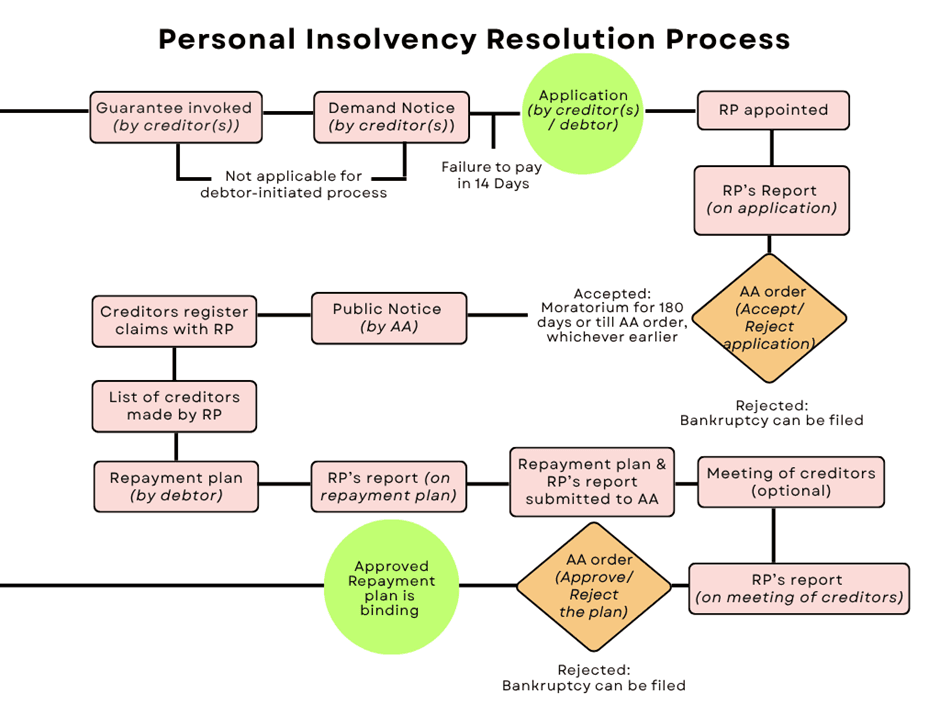
A concise overview of the personal insolvency and bankruptcy framework for personal guarantors under the IBC, with key NCLAT and NCLT rulings shaping the law. This piece explains initiation, moratoriums, repayment plans, creditor rights, bankruptcy triggers, and the 2025 Amendment Bill, offering a clear snapshot of the evolving jurisprudence and its practical implications for stakeholders.