
Introduction
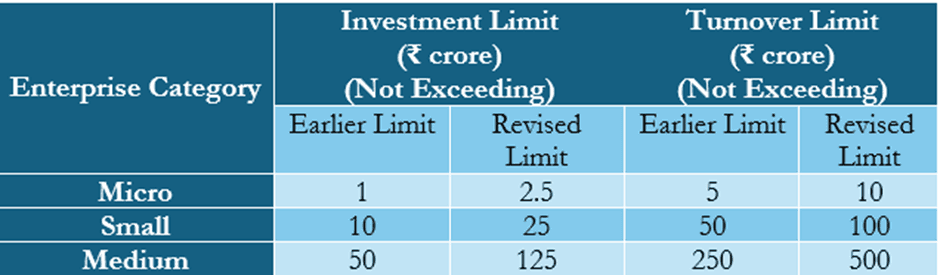
The Ministry of Micro, Small and Medium Enterprises (‘MSMEs’), through a Notification[i], has amended the existing criteria for classifying enterprises as Micro, Small, and Medium under s. 7 of the MSME Development Act, 2006 (‘Act’). The amendments revise the threshold limits for investment in plant and machinery/equipment and turnover, effective from 01.04.2025.
Background
Earlier, the classification of MSMEs was based on investment and turnover thresholds as notified in the earlier Notification[ii]. Based on the recommendations of the Advisory Committee constituted under the Act, the Central Government has enhanced these thresholds to broaden MSME coverage and enable larger enterprises to avail MSME benefits.
Revised Classification Criteria
The following table summarizes the revised investment and turnover limits for MSMEs classification:
Our Analysis
The amendments to the earlier Notification, as outlined in the amended Notification, represent a significant policy shift aimed at broadening the scope of enterprises qualifying as Micro, Small, and Medium Enterprises under s. 7 of the Act. By enhancing the investment and turnover thresholds, the Central Government has aligned the classification criteria with prevailing economic conditions, inflationary trends, and evolving industry demands. This revision is expected to extend statutory benefits under various schemes, such as priority sector lending, tax concessions, and public procurement incentives, to a wider base of enterprises. The revised thresholds are also likely to improve the flow of institutional credit to mid-sized enterprises that were previously excluded from the MSME ambit, thereby reducing their reliance on high-cost informal financing.
Moreover, the broadened eligibility criteria necessitate focused outreach and capacity-building efforts to ensure that newly eligible enterprises are aware of, and able to access, the benefits under the Udyam registration framework.
However, enterprises seeking reclassification are required to update their Udyam Registration in a timely manner in accordance with the revised thresholds to remain compliant and continue to be eligible for benefits under the Act.
End Notes
[i] No. S.O. 1364(E) dated 21.03.2025.
[ii] No. S.O. 2119(E) dated 26.06.2020.
Authored by Onam Singhal, Chartered Accountant at Metalegal Advocates. The views expressed are personal and do not constitute legal opinions
More Insights

25-08-2026
12
min read
A Game of Treasure Hunt: Service of GST Notices and Orders under S. 169 of the CGST Act and the Emerging Split Among High Courts
Luxmi Traders addresses a fundamental question in GST adjudication: can a notice or order be treated as duly served merely because it is uploaded on the Common Portal? The Punjab and Haryana High Court held that portal-only service, absent the requisite statutory and notified basis, cannot by itself defeat a taxpayer’s remedies. With Madras and Allahabad adopting different approaches and Delhi subsequently applying Luxmi Traders, the issue reflects a significant divergence in judicial approach awaiting authoritative resolution.

24-07-2026
10
min read
‘Shylockian’ Lending is ‘Squeezing of Blood’: NCLT Moves Beyond Debt & Default to Reject a Section 7 Application
In a rare departure from the conventional debt-and-default enquiry under section 7 of the IBC, the NCLT, Kochi Bench rejected the financial creditors' petition after characterizing the underlying arrangement as a ‘Shylockian system’ of lending. This court ruling discusses Shylockian lending and examines the strength of the Tribunal's focus on the economic substance of the transaction against established legal principles governing admission under section 7 of the IBC.

10-07-2026
7
min read
Faceless Reassessment after S. 147A: What the Supreme Court Did – and Did Not – Decide
The Supreme Court's decision in Tej Pratap Singh does not settle the JAO–FAO controversy. Following Parliament's retrospective insertion of s. 147A, it remands the issue to the High Courts for fresh consideration. Faceless reassessment was never merely about moving tax files from paper to portal; it fundamentally changed the statutory authority responsible for communicating with the taxpayer, examining the record, drafting the order and completing the assessment. The real question now is how far a retrospective legislative clarification can go.