
Introduction
The Central Board of Direct Taxes (‘CBDT') has released an explanatory circular[i] that outlines key amendments to the Income-tax Act, 1961 (‘the Act’) and other statutes, which were made through the Finance Act, 2023 (‘FA 2023’). This pivotal circular provides insights into the updated tax regulations. It details changes in the tax structure, rates, deductions, exemptions, compliance, and administration, with the objectives of simplifying the tax system, reducing the tax burden, promoting digital transactions, and enhancing compliance and transparency. Enacted as Act No. 8 of 2023, the FA 2023’s provisions pertaining to direct taxes are comprehensively explained in this circular, providing essential guidance for stakeholders in navigating the amended tax landscape.
Key Changes
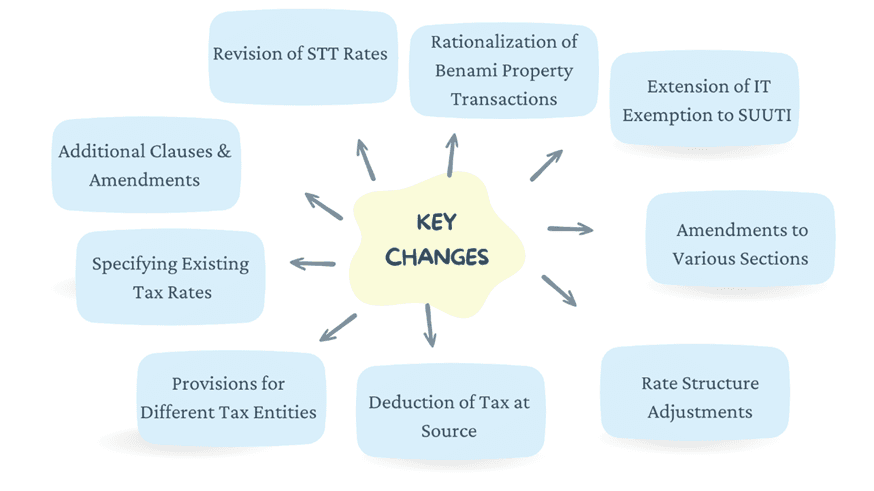
The key changes introduced in the Act through the FA 2023 are comprehensive and multifaceted, addressing various aspects of tax law and the same can be broadly classified under 3 heads - changes in tax rates and slabs, changes in deductions and exemptions, and changes in tax compliance and administration.
Changes in Tax Rates and Slabs
FA 2023 introduced a new optional tax regime for individuals and Hindu Undivided Families (‘HUFs’), under which they can opt to pay tax at lower rates, subject to the condition that they forego certain deductions and exemptions. Taxpayers can apply the new tax regime from the assessment year (‘AY’) 2024-25 onwards. They must opt for this regime before filing their annual income return. The surcharge and cess applicable to the individuals and HUFs remain unchanged at 10%, 15%, 25%, and 37% for the total exceeding Rs. 50 lakhs, Rs. 1 crore, Rs. 2 crores, and Rs. 5 crores, respectively, and 4% for the health and education cess.
Changes in Deductions and Exemptions
FA 2023 also made several changes in the deductions and exemptions available to taxpayers under the new tax regime. The taxpayers who opt for the new regime will have to give up many tax benefits such as the standard deduction, House Rent Allowance (‘HRA’), interest on housing loans, savings schemes, donations, and medical expenses.
However, some tax benefits will still be available under the new regime such as the employer’s contribution to the provident fund, superannuation fund, and the national pension system, gratuity, leave encashment, income from life insurance policies, and the specified exempt allowances. The taxpayers should be mindful of these changes and plan their tax-saving strategies accordingly.
Changes in Tax Compliance and Administration
Faceless assessment and appeal system: This system aims to eliminate the physical interface between the taxpayers and the tax authorities and to ensure uniformity and transparency in the tax administration. The taxpayers will not have to visit the tax office or meet the tax officer in person and will be able to file their responses and documents online. The system will also have a review mechanism and a penalty provision for non-compliance.
TDS and TCS provisions: These provisions have been expanded to cover more transactions and payments such as e-commerce transactions, foreign remittances, and cash withdrawals. These provisions aim to ensure the timely collection of tax and the reporting of income by the taxpayers. The rates and thresholds of TDS and TCS have also been revised for some of the transactions and payments such as interest income, dividend income, professional fees, etc.
Penalty and prosecution provisions: These provisions have been rationalized to reduce litigation and provide relief to the taxpayers. Penalty will be levied, and prosecution initiated only in cases of wilful default or evasion of tax, and not for minor or technical errors. These provisions have also been aligned with the faceless assessment and appeal system and the reduced tax rates.
Settlement commission and advance ruling authority: These bodies have been amended to streamline their functioning and widen their jurisdiction. The settlement commission allows the taxpayers to settle their tax disputes with the tax authorities by paying the tax and interest due and avoiding the penalty and prosecution. The advance ruling authority allows taxpayers to seek a binding ruling on the taxability of a transaction or an issue before undertaking it. These bodies have been amended to include more types of taxpayers and cases such as non-residents, charitable trusts, transfer pricing cases, etc.
Conclusion
These amendments reflect the government’s endeavour to align the tax system with the evolving economic landscape and administrative requirements. These changes aim to simplify tax compliance, address the complexities of modern financial scenarios, and ensure fair and effective tax administration. By revising tax rates, adjusting the structure for different categories of taxpayers, and updating various sections of the Act, the amendments facilitate a more efficient, equitable, and transparent tax regime. This proactive approach underscores the commitment to adapting fiscal policies to current needs, benefiting a wide range of stakeholders and strengthening the overall taxation framework.
End Note:
[i] Circular No. 1/2024 dated 23.01.2024.
Authored by Srishty Jaura, Advocate at Metalegal Advocates. The views expressed are personal and do not constitute legal opinion.

AUTHORED BY
More Insights

25-08-2026
12
min read
A Game of Treasure Hunt: Service of GST Notices and Orders under S. 169 of the CGST Act and the Emerging Split Among High Courts
Luxmi Traders addresses a fundamental question in GST adjudication: can a notice or order be treated as duly served merely because it is uploaded on the Common Portal? The Punjab and Haryana High Court held that portal-only service, absent the requisite statutory and notified basis, cannot by itself defeat a taxpayer’s remedies. With Madras and Allahabad adopting different approaches and Delhi subsequently applying Luxmi Traders, the issue reflects a significant divergence in judicial approach awaiting authoritative resolution.

24-07-2026
10
min read
‘Shylockian’ Lending is ‘Squeezing of Blood’: NCLT Moves Beyond Debt & Default to Reject a Section 7 Application
In a rare departure from the conventional debt-and-default enquiry under section 7 of the IBC, the NCLT, Kochi Bench rejected the financial creditors' petition after characterizing the underlying arrangement as a ‘Shylockian system’ of lending. This court ruling discusses Shylockian lending and examines the strength of the Tribunal's focus on the economic substance of the transaction against established legal principles governing admission under section 7 of the IBC.

10-07-2026
7
min read
Faceless Reassessment after S. 147A: What the Supreme Court Did – and Did Not – Decide
The Supreme Court's decision in Tej Pratap Singh does not settle the JAO–FAO controversy. Following Parliament's retrospective insertion of s. 147A, it remands the issue to the High Courts for fresh consideration. Faceless reassessment was never merely about moving tax files from paper to portal; it fundamentally changed the statutory authority responsible for communicating with the taxpayer, examining the record, drafting the order and completing the assessment. The real question now is how far a retrospective legislative clarification can go.